“Where steel sharpens steel”: Inside Ypsilanti’s decade-long hip-hop haven
As hip-hop artist Diont’e Visible prepares to release his new album, Ypsi’s long-standing open mic series, The Dojo, founded by Harlin Duke Newcomb and housed by the Regal Beagle, celebrates 10 years.
Before The Dojo became a home for hip-hop artists in Ypsilanti, it was an idea sparked by a simple question: What could one artist do to help others grow?
Nearly a decade later, Harlin Duke Newcomb’s monthly open mic, held the first Friday of every month, has become a gathering place for emcees to test new material, build confidence, and connect with a community that values their craft.
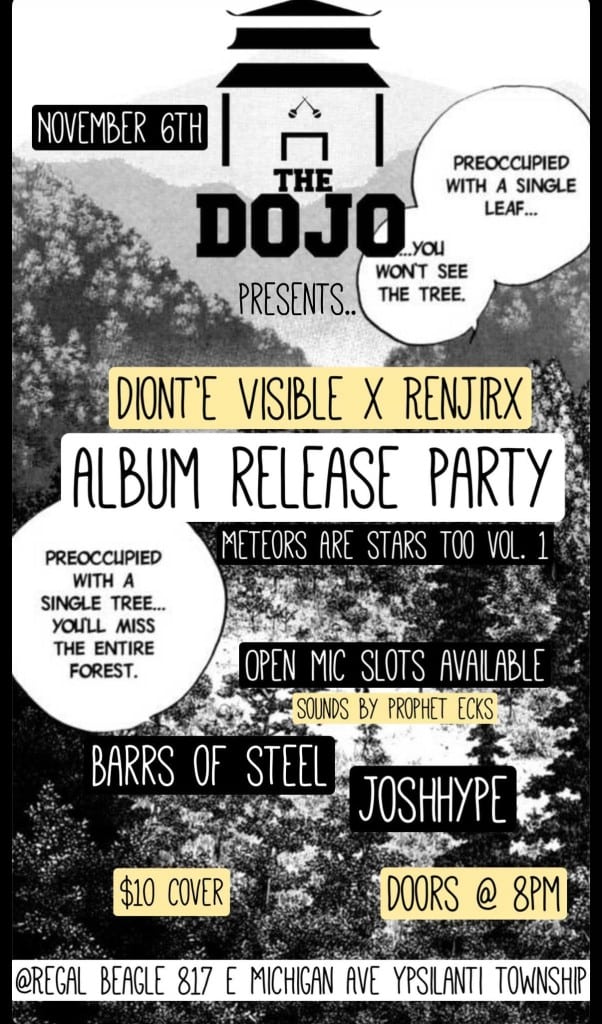
On Friday, Nov. 6, that spirit will meet a new creative chapter when local artist Diont’e Visible brings his album release for Meteors Are Stars Too, Vol. 1 to the Regal Beagle, 817 E. Michigan Ave in Ypsi, which The Dojo now calls home.
Newcomb launched The Dojo in 2015 after releasing his album Duke Newcomb: Ground Zero. Unsure how to move his own music forward, he sought advice from people he respected, including Dante LaSalle, an emcee, DJ, and promoter who built a name for himself throughout the region. LaSalle encouraged Newcomb to think beyond his own music and consider what he could offer the communities he hoped to reach. Newcomb saw an opportunity to create an open mic specifically for emcees at a time when he felt the Ann Arbor area lacked a viable hip-hop scene.
He initially planned to call the event Ground Zero. Then a younger emcee offered a different idea.
“A young emcee by the name of B.L.A.S. pulled me to the side and said, ‘The Dojo, call it The Dojo,’” Newcomb says.
The name became more than a title. It established the philosophy behind the gathering.
“It has come to mean a place where we train together,” Newcomb says. “A Dojo is the Japanese martial arts equivalent of a boxing gym. That’s what it is to Dojo goers.”
The first event, which was held at the Elks Lodge on Spring Street, drew about five people. Attendance grew to 15, then 40, before word spread beyond the local scene. Newcomb remembers one night when the venue was so packed that people stood on the stairs trying to catch a glimpse of the performances. After the pandemic interrupted the series, The Dojo returned to the Blind Pig in Ann Arbor before moving to the Regal Beagle. For Newcomb, the latter offered something important: a more intimate environment where emerging artists could feel comfortable taking the microphone.
Although the Regal Beagle has long been associated with punk rock, Newcomb sees common ground between the two musical cultures.
“Philosophically, hip-hop and punk rock have the same roots,” he says. “It was kinda grimy and antiestablishment in vibe and aesthetic. To me that was perfect.”
Today, Newcomb’s role extends well beyond hosting. He coordinates performers, DJs, sound, schedules, and featured artists’ payments. Yet The Dojo’s guiding principle remains straightforward: give artists a chance to develop without demanding perfection.
“Our motto is: ‘We don’t care if you’ve been doing this for 20 years, or 20 minutes. This is your chance to share and compare. Where steel sharpens steel. This is where we congregate, network, and express,’” Newcomb says.
Watching artists grow has become one of his greatest rewards. “Everyone who has participated has improved leaps and bounds,” he says. “It’s one of my favorite things in the whole deal.”
Visible understands that value firsthand. Before finding The Dojo, he attended poetry open mics in search of opportunities to develop his performance skills. He eventually found a hip-hop-focused space where artists could share their work and learn from one another.
“As an artist it’s invaluable to have somewhere to go to see how some material you wrote works or get to meet other artists and see how they hone their craft. Or just express yourself,” he says.
That community also made The Dojo the natural setting for Visible’s upcoming release.
Meteors Are Stars Too, Vol. 1 is a multimedia project developed over four to five years with his friend and collaborator RenjiRx.
Visible says the album isn’t so much the “personal story [of] my life” as it is “an attempt to have each character embody an ideology and really throw myself into the role of telling their story while embodying a human experience.”
Visible describes his musical identity as “your favorite jazzy Afrofuturistic sci-fi surrealist” emcee. His influences include underground hip-hop, anime, and manga, inspirations that inform a performance he says will be unlike anything he has presented before.
“This will be the first set I’ve ever done where everything is completely sci-fi futuristic,” Visible says.
Bringing the album to life was not easy. Visible endured years of financial and creative setbacks, including previous projects that never reached release. Completing this one required determination to keep moving forward.
Over email, he writes, “NO MORE WILL I BE SHELVED BY THE CORPORATE MARKET THAT WOULD SEE ME RESIGN MY DREAMS TO A HAMSTERWHEEL.”
For Visible, the release is both a personal milestone and an opportunity to share something meaningful with the community that helped him develop as an artist.
Newcomb, meanwhile, hopes The Dojo’s next chapter includes greater financial stability and partnerships that will allow the series to expand. He believes independent arts spaces deserve investment because they help sustain the culture that communities depend on.
“It’s time to realize that art is necessary for there to be culture,” Newcomb says. “Without culture, what do we really have?”
On Nov. 6, The Dojo will once again demonstrate what can happen when artists have a place to gather, experiment, and share their work. For Visible, it is the beginning of a larger creative universe. For Newcomb, it is another opportunity to do what he set out to accomplish in 2015: give artists a place to grow. After nearly a decade, the work continues, one performance, one connection, and one sharpened craft at a time.
Related Articles
Ann Arbor-produced web series “Grumpy Phil” returns this month with new episodes
“Grumpy Phil,” an Ann Arbor-produced web series about a grumpy, middle-aged fellow with an axe to grind and the things that annoy him, returns this month with new, free-to-watch episodes.
State of the Arts program brings U-M faculty artists to communities across the state
U-M’s State of the Arts program, launched by the Arts Initiative, aims to bring meaningful experiences in the arts to communities around the state.