
U-M launches two new solar arrays, pursuing ambitious greenhouse gas reduction goals
The University of Michigan has brought two new solar arrays online on its North Campus.
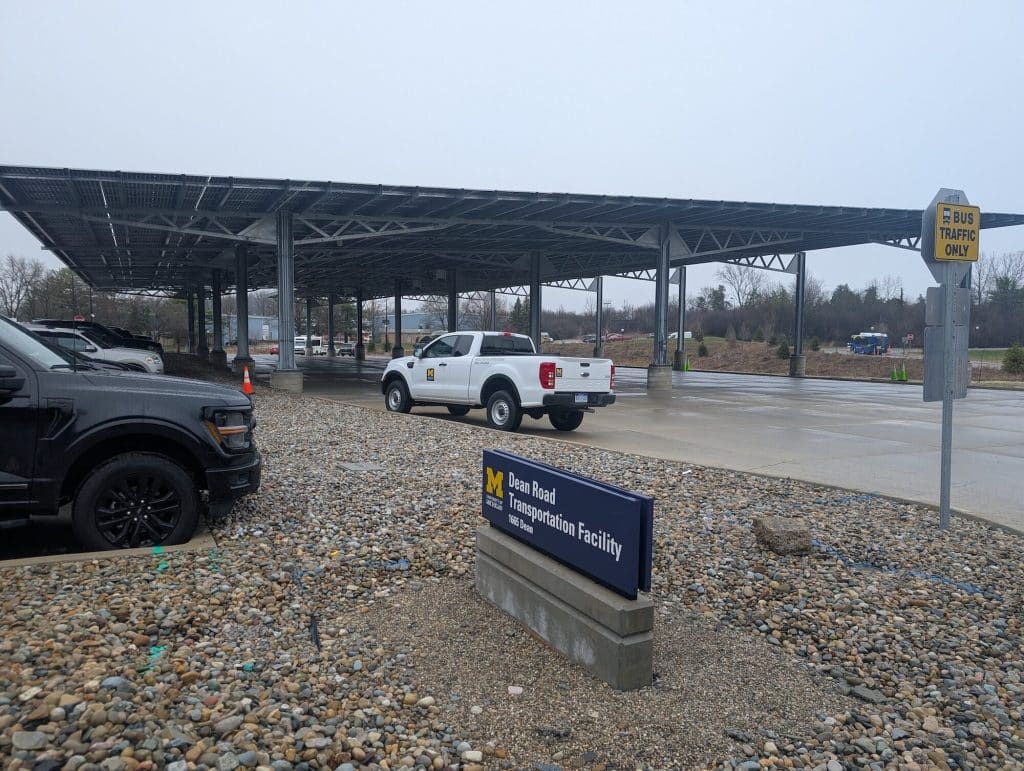
As part of an effort to expand on-campus solar generation and strengthen long-term energy resilience, the University of Michigan (U-M) has brought two new solar arrays online on its North Campus. The two arrays expand on Maize Rays, an initiative supporting the university’s vision of eliminating Scope 2 greenhouse gas emissions, which are caused by energy production.
“The University of Michigan has goals to reduce our reliance on fossil fuels and to really demonstrate systems that are good for people and the planet,” says Shana Weber, associate vice president for campus sustainability and innovation. “This is one leg of the journey to address where our sources of electricity come from, and one piece of the puzzle [is] installing as much solar on campus as we can.”
Located at the North Campus Administrative Complex, the installation includes both rooftop panels and solar carports. Combined, they have a power generation capacity of approximately 0.73 megawatts – bringing total on-campus solar generation capacity to 2.5 megawatts across seven locations on U-M’s Ann Arbor and Dearborn campuses.
“What we have installed so far is kind of the equivalent of what would be needed for about 300 average Michigan homes,” Weber says.
There are installations at the North Campus Facilities Services Building and the Tony England Engineering Lab Building in Dearborn. They come ahead of other, more complex efforts. An additional 1.1 megawatts of on-campus solar capacity are currently in the works.
“What are the easiest sites to install first? Where can we get all of our lessons learned on sites that are relatively straightforward to do?” Weber says. “The other sites on the list are really kind of organized in that way.”
The university’s overall goal is to develop 25 megawatts of on-campus solar generation capacity across their properties. Weber says it’s especially meaningful that a portion of the project will be “dedicated to installing solar panels out in the community, in partnership with the community.”
“We don’t decide where those go. The community decides, but we agree on an initial set of principles,” she says. “The principle that we agreed on was that the solar panels would be deployed on buildings that host community-serving organizations.”
All of the installations are expected to be completed in three years. Weber underscores that the overall impact for the university will be pivotal.
“There’s the campus solar, and we’re also working on off-site solar. Those two things combined means that when we’re done installing, we’ll have accounted for all of the electricity that the University of Michigan uses,” she says. “All the electricity will come from verified Michigan-based renewable sources.”
The project will also serve as a valuable learning tool for the community. A lot of the panels will not be visible from the ground because they’ll be on rooftops. However, some will be in parking areas, where there will be solar parking canopies or panels on top of parking garages. As installations start to become more visible, they’re intended to become a community learning tool.
“It becomes an educational showcase where we can have more conversations. How is it working? What are the benefits? How is the technology changing?” Weber says. “We’re an educational institution, so we want to stimulate conversations, and having visible systems helps with that.”
Author

Related Articles

Students lead successful effort to reduce waste at annual forum at EMU
Eastern Michigan University (EMU) students spearheaded a recent effort to transform the annual Southeast Michigan Stewardship Coalition Community Forum into a zero-waste event for the first time.

Ypsi’s We the People Opportunity Farm will continue founder Melvin Parson’s mission after his sudden passing
Leadership at Ypsilanti nonprofit We The People Opportunity Farm is focused on ensuring the organization continues founder Melvin Parson’s legacy after his unexpected death.
Ann Arbor pilot offers $1 million in incentives for energy efficiency upgrades in rental properties
The Ann Arbor Office of Sustainability and Innovations and DTE Energy are piloting a new program that offers up to $1 million in incentives for multifamily rental property owners looking to invest in energy efficiency upgrades.


