
Michigan League of Handweavers’ biennial show in Ann Arbor will feature myriad disciplines
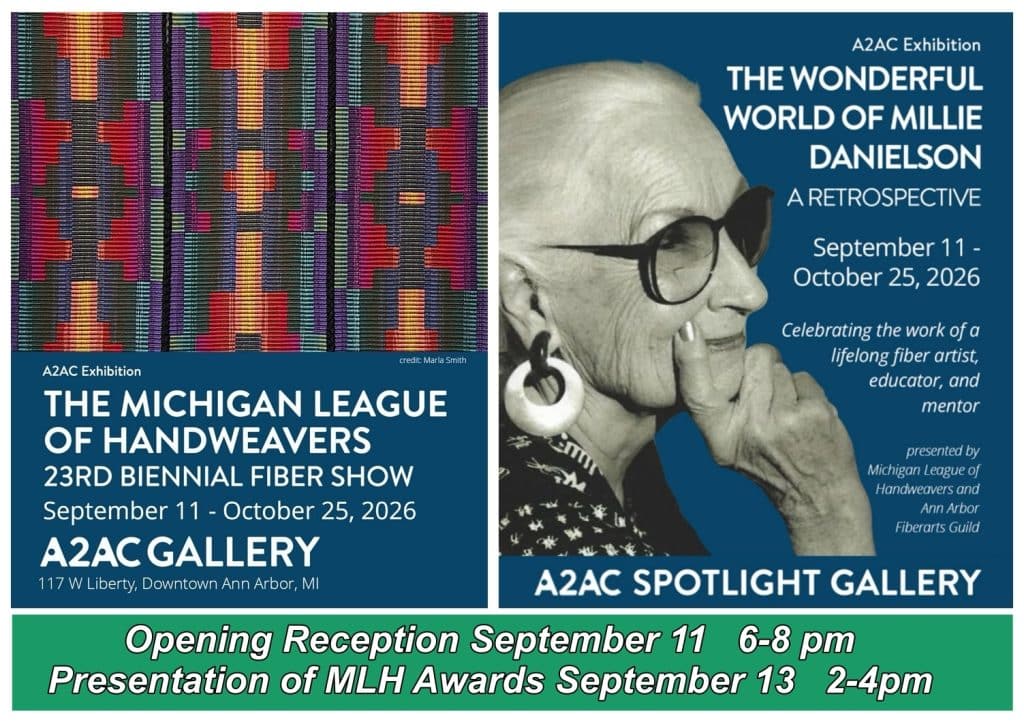
From weaving to doll-making, a broad range of craftsmanship will be featured in both exhibitions and public demonstrations at the Michigan League of Handweavers’ 23rd Biennial Fiber Show.
This story is part of a series about arts and culture in Washtenaw County. It is made possible by the Ann Arbor Art Center, Destination Ann Arbor, Larry and Lucie Nisson, the University of Michigan Arts Initiative, and the University Musical Society.
From weaving to doll-making, a broad range of craftsmanship will be featured in both exhibitions and public demonstrations at the Michigan League of Handweavers’ (MLH) 23rd Biennial Fiber Show. The show is set for Sept. 11-Oct. 25 at the Ann Arbor Art Center (A2AC), 117 W. Liberty in Ann Arbor.
Alongside displays of members’ work, biennial committee chair Barb Schutzgruber says this year’s show will also offer fiber workshops at the A2AC and “a variety of demonstrations” in its gallery space, all of them open to the public.
Visitors are also invited to contribute to a community weaving project using a tapestry loom that will be on hand. No prior experience is necessary — or, as Schutzgruber says, “You don’t have to know what you’re doing.”
The MLH itself is currently made up of around 500 members, some of whom belong to the 22 smaller guilds (most of them local community groups, like the Ann Arbor Fiberarts Guild, which is hosting the A2AC show) that comprise the whole. And despite the name, members aren’t limited to those living in Michigan: though most are concentrated in the Great Lakes region, the MLH also has members in South Carolina and California.
In the early days after the MLH’s 1958 founding, the league was primarily made up of weavers, Schutzgruber says. Now, members’ techniques include not only weaving but also spinning, felting, knitting, crocheting, knotting, quilting, dyeing, embroidery, surface design, garment design and construction, bead-weaving, papermaking, basketry, and even doll-making.
All those techniques will be on display at the biennial, as will the use of both natural fibers (meaning plant and animal fibers such as wool, silk, etc.) and non-traditional materials. Schutzgruber says non-traditional materials can include just about anything, from paper and wire to audio cassette tape.
Participating artists may enter in one of two categories: fiber art, “which tends to be sculptural — [like] things [you hang] on the wall,” and functional art, “for people who make garments, shawls, things that have a practical purpose,” Schutzgruber says.
That’s “because art is not simply something you put on a shelf or on a wall,” she adds — a particularly important point for Schutzgruber.
“Throughout history, people rarely … had time to make art just for art,” she says. But since we’ve “had to make things anyway, that’s where they put their artistic effort,” she goes on. “That’s why we have carved furniture, garments, basketry — things that had a practical purpose and … are still amazing pieces of art.”
Each category will present first-, second-, and third-place winners, alongside honorable mentions. The show will be juried by Ann Arbor resident Cathryn Amidei, who Schutzgruber says is “nationally known as a weaver and fiber artist.”
Some of the pieces shown in the exhibition will be for sale, and MLH members will offer additional items for sale in the A2AC gift shop.
Alongside the exhibition, the MLH will also present a retrospective of the work of Millie Danielson. Schutzgruber describes Danielson as “an amazing textile artist” who wove garments and tapestries, sometimes using nontraditional materials like wires. Danielson passed away a few years ago, just shy of 102, according to Schutzgruber.
“She would take all sorts of weird stuff [and incorporate it into her work],” Schutzgruber says. “You wondered, how does her brain work?”
Two years ago, Schutzgruber herself won first place in functional art at an MLH show for “a wearable 1959 wrap cocktail dress” made from 22 National Geographic maps. Schutzgruber says she started out as a weaver 40 years ago.
“I was a kid who loved watching the demonstrators at places like Greenfield Village or any historical kind of setting,” she says.
But it wasn’t until Schutzgruber was grown, with kids of her own, that she heard about a woman in Northville who gave weaving lessons out of a small home studio.
“My kids were babies, so it was my night out with grown-ups. Yay!” Schutzgruber says. “I took a class, learned some very good basics, bought a loom, and have been weaving ever since.”
She’s been part of the MLH for decades; in fact, she can’t remember exactly when she joined. But she says the organization has been a great “way to connect” with others who share her interest, as well as a way to “improve [her] own skills.” (The MLH frequently offers workshops and other events.)
“When human beings first figured out how to twist fiber to make string — for me, that was probably one of the biggest events in human evolution,” Schutzgruber says. “…This is a way to connect to your roots.”
Author

Related Articles
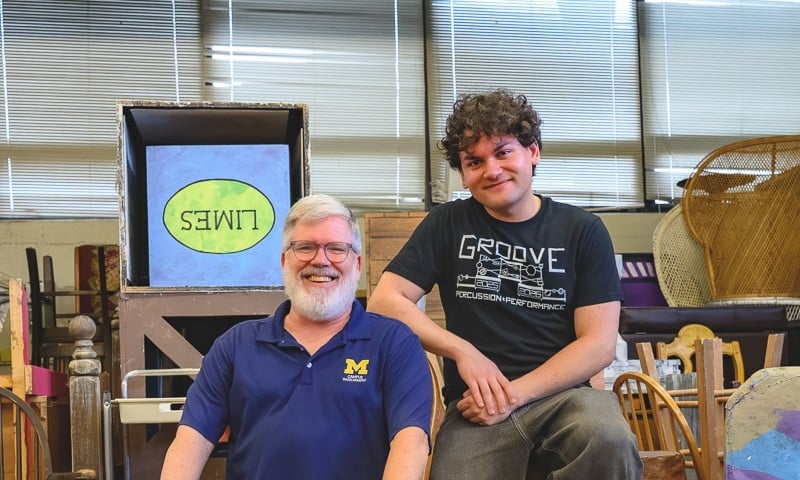
From building a train to hosting an alpaca, this U-M facility serves student performers’ needs
For about 50 years, the University of Michigan’s Student Theatre Arts Complex has been quietly providing crucial pre-production support to student-run theater and other performance groups.
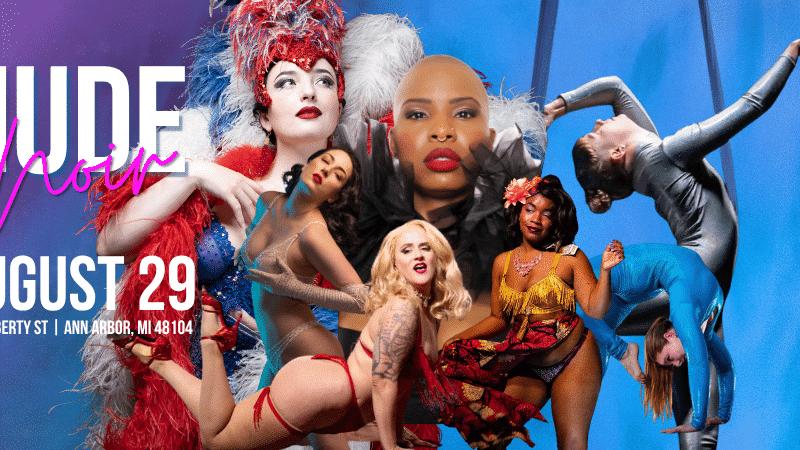
Nude Noir brings “celebration of the human form” to Ann Arbor’s Michigan Theater
Nude Noir attendees are invited to roam the Michigan Theater as performances — from burlesque and drag to aerialists and contortionists — unfold around them.
UMS to bring jazz, puppets, square dancing, and more to latest Ypsi residency
The University Musical Society (UMS) will return to Ypsilanti’s historic Freighthouse this fall for a nearly three-week residency.


