
EMU’s Center for Oral History Research hosts symposium emphasizing “People, Not Projects”
“People, Not Projects” runs Oct. 9 – Oct. 10 in Ypsi and will emphasize relationships and human experience over quantitative data.
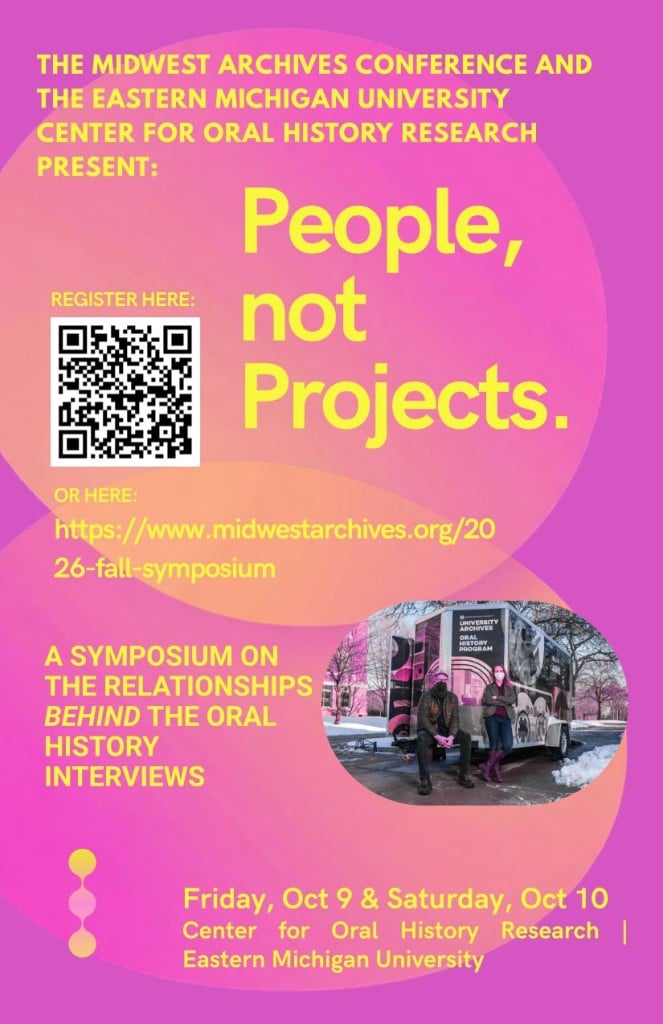
This weekend, Eastern Michigan University’s Center for Oral History Research (COHR) is hosting a symposium centered on the concept that “drives everything we do,” says Alexis Braun Marks, university library department head, archivist, and associate professor.
That’s the idea “of centering communities and interviewees, or narrators, first and foremost,” in research that draws upon oral history and archival materials—and in maintaining those archives in the first place.

The symposium, “People, Not Projects,” runs Friday, Oct. 9 – Saturday, Oct. 10 at 955 West Circle Drive in Ypsilanti, and is co-hosted by the Midwest Archives Conference.
The event is open to all, not just to academics and archivists or those affiliated with EMU. And while registration for the event has now closed, the keynote address will be recorded and made available online, where those interested can also access COHR’s past work.
Marks says the symposium will feature talks and discussions with COHR’s past partners, including narrators, or those who have participated in oral history interviews, describing their life experiences.
Instead of putting together “another day-and-a-half workshop on how to do oral history,” Marks says, she and COHR director Matt Jones asked, “How can we highlight what makes our program and approach so different from other programs, in a way that would be helpful for other practitioners?”
Marks says it’s common for oral history programs around the country to place great value in quantitative results—boasting, for example, “We have [collected] 10,000 interviews.”
Those figures might disguise the fact that many of the interviews haven’t been transcribed, or aren’t available to be listened to, or any other number of issues, Marks says.
Worse, the process becomes about “amassing all of this information without any real ethical consideration” for the narrator’s role in the process, which is “a very intimate [one],” Marks says.
“You are asking people to be incredibly vulnerable, divulging stories often around very, very difficult traumatic events.”
COHR’s goal, Marks adds, isn’t merely quantitative.
“Our approach has always really been about the narrator,” she says. “It’s more about relationships that we’re developing over time and the importance of those relationships,” she says.
That means “giving people space to reflect on an experience that they’ve had,” rather than working through a predetermined checklist of questions.
As researchers, “we’re really just there as gentle guides to move the conversation along, to prompt them,” she says.
But it also means giving the narrator the opportunity to review their interview once it’s complete and make corrections.
These changes can be small—a narrator might say, “I don’t know why I said her name was Anne. It’s Alexis,” Marks says—or not so small: “[I] shouldn’t have said that. I need this to be omitted from the interview.”
That emphasis on the relationship between researcher and narrator is at the core of COHR’s work.
“When we’re talking to graduate students and we’re working with communities, it is less about, ‘We want to document Black farmers in Ypsilanti—let’s just interview as many Black farmers as possible,’” Marks says. “It’s more about: Does the community want to participate in something like this? What is the goal of the project? How can we work with [participants] in a way that their stories feel honored, and they feel like we’re not just parachuting in to collect these stories and get out?”
Questions like these will inform discussions at this weekend’s symposium, but Marks says participants will also “certainly walk with some technical skills,” from transcribing interviews to using recording equipment and engaging in active listening.
COHR’s mobile oral history booth, which they’ve named the Aerie, will also be on hand for tours and to make recordings.
Marks says COHR’s work is also partly about correcting or supplementing the work of prior archivists and researchers, who have traditionally prioritized “certain narratives…over others for preservation.”
“We have a lot of male faculty, male administrators, male regents, most of whom are white, whose stories have been collected and preserved,” she says.
While those figures are “important to the function of academics, they are not the people on the ground creating culture and making change.”
“There were stories that were not in the physical archive, stories that had been lost, because people had been told by previous archivists, ‘That’s not really something we want’—or they felt they didn’t have a story that was important enough to be in the archives.”
“All history is subjective,” Marks adds. “Archivists are shaping the narrative by what we decide to keep, preserve, and provide access to.”
COHR intends to “give people the opportunity to know and understand that their experience has value, and that [even if] they are not at the front of the line, walking over the bridge in Selma, that they still have…played a part [in history],” she says.
“That’s the value of oral history: It allows people to see themselves in the historical record, and it makes our collections all the better for it.”
Author

Related Articles
Grizzly Learning Camp offers free, hands-on learning for all Ypsi Community Schools students
At GLC, students spend their summers building robots, designing escape rooms, learning to fish, and visiting local college campuses all while working with teachers, university students, and mentors.
Childcare workforce crisis fuels push for wage reforms
Without sustained investment, families will continue to have difficulty accessing stable, high-quality childcare.


