
Ann Arbor’s second annual Atomic Games challenges programmers to build an AI in a weekend
Custom software company Atomic Object hosts the games to identify talented programmers and to occasionally recruit participants who do well.
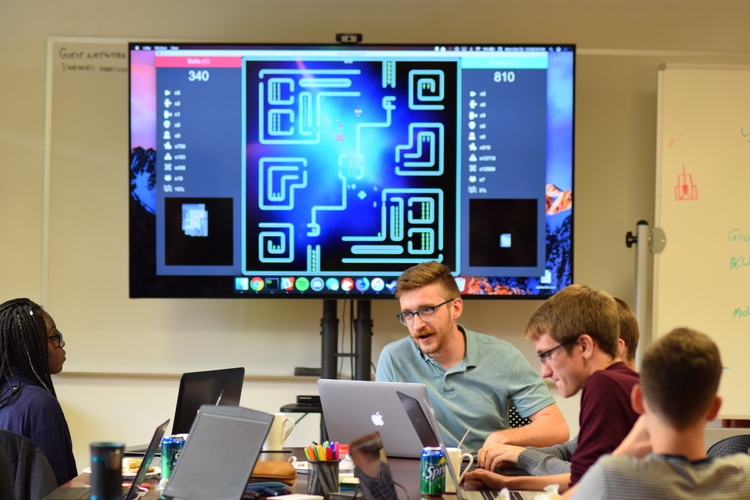
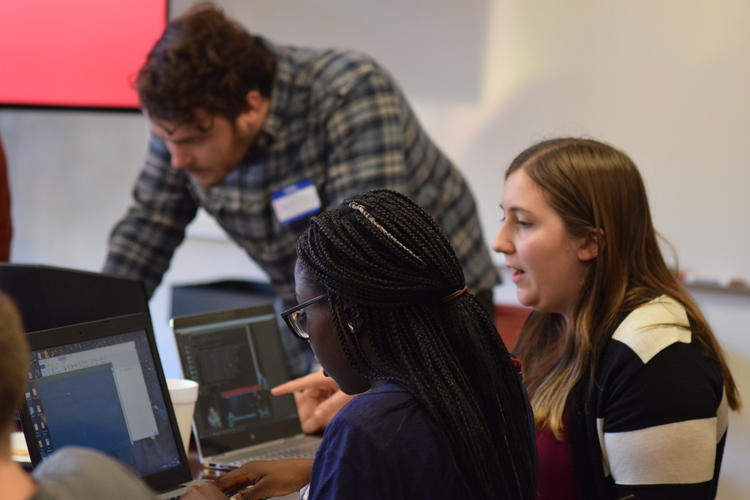
Daniel Michelin, a senior at Kalamazoo College, was the clear winner in the 2017 Atomic Games Ann Arbor, a computer programming challenge that requires participants to create an artificial intelligence (AI) over one weekend.
Custom software company Atomic Object has hosted the games for three years in Grand Rapids, and for two years in Ann Arbor. The games help the company identify talented programmers and to occasionally recruit participants who do well.
“Atomic Object, over its 16-year history, has had difficulty hiring developers straight out of college,” says Jonah Bailey, a managing partner in the Ann Arbor office who organized the Ann Arbor games. “What college teaches is a highly theoretical base that will serve them well throughout their career, but what they often lack are technical skills and a chance to apply that theory in practice.”
The Atomic Games require contestants to log into a server where a “boilerplate” game is uploaded. Last year’s game was a version of Connect Four, while this year’s game was similar to the popular strategy game Starcraft. Over one weekend, participants program a real-time strategy AI to play the game. The contestants’ AIs then face off against each other, and the winning developer takes home a $500 prize. Seventeen programmers competed for the prize in Ann Arbor last year. This year 21 participated over the long weekend of Oct. 20-23.
Bailey says Michelin won “pretty resoundingly.” He says Atomic Object doesn’t just look for winners but also looks for participants who get up and running quickly, who offer to help others, and who generally show “outstanding leadership abilities.”
Bailey also says students who had a passion for programming before they entered college often do well in the games. That was the case for Michelin, who took a programming course in middle school and went to summer camp for programming during high school.
Once in college, Michelin initially thought he would study political science but switched to computer science and math his sophomore year. While studying at Kalamazoo College, Michelin has participated in other coding challenges and even runs a few coding competitions with fellow students.
“I really like being challenged to think a lot in the span of a little bit of time,” he says. “But I have only taken one machine learning class and have never done anything with AI, so I actually thought I was going to get my butt whipped by kids from the University of Michigan. I was surprised that I won.”
He attributes his success in the Atomic Games to the fact that he plays a lot of chess and other strategy games, which helped him during the programming challenge.
“He really got the game, understood it, and worked hard over the weekend,” Bailey says.
Sarah Rigg is a freelance writer and editor in Ypsilanti Township. You may reach her at sarahrigg1@gmail.com.
Photos courtesy of Atomic Object.
Author

Related Articles

Ypsi Community Schools and Lincoln Consolidated Schools collaborate on learning initiative
The 3P Champions Collaborative Learning Initiative aims to develop a curriculum focused on STEM and experiential learning–and to pair teachers with “champions” experienced in the new approach. Students in pre-K–12 classrooms have been delving into hands-on, project-based learning while their teachers see increased support and leadership.

Ypsi officials and activists prepare for climate emergency
As extreme heat, wildfire smoke, and power outages become more and more prevalent in Washtenaw County, a growing network of local officials, health professionals, and community organizers is working to help Ypsilanti residents do more than simply weather the next emergency.

EMU’s Center for Oral History Research hosts symposium emphasizing “People, Not Projects”
“People, Not Projects” runs Oct. 9 – Oct. 10 in Ypsi and will emphasize relationships and human experience over quantitative data.


