

Author

Tanya Muzumdar

Tanya Muzumdar's Latest Articles

Ypsilanti Food Co-op expands to sate growing appetites

There's a dust-up at the Ypsilanti Food Co-op, we're told, in prep for what'll be a redo of its space in Depot Town. Demolition started a couple of weeks ago. When complete by summer's end, the grocer will occupy the entire 5,000-square-foot ground floor of the Historic Mill Works Building, according to General Manager Corinne Sikorski. The project, costing in the range of $250,000, entails a reconfiguration of the space and a 50% increase in retail square footage. Also on the plate: a seating area for the deli, and the River Street Bakery will get more workspace and a new direct sales counter. The dairy cooler will grow from seven to 10 doors and a five-door freezer is to be added. Expect a doubling of the frozen food selection and more bulk bins, Sikorski says. "We're a full-line grocery store, and this is going to help us be a more complete full-line grocery store in a natural-foods way," she adds.Although sales more than doubled over the last five years, Sikorski says, space constraints were crimping growth. The Ypsilanti Food Co-op is open to the public and has about 750 active members; roughly half of the regular customers are members. It will be open during the renovation. Sikorski cites the desire to be a community mainstay; the grocer has been in the circa-1840s building since 1984. "We really wanted to expand by just continuing that store here, rather than moving to a bigger store somewhere else."Source: Corinne Sikorski, general manager, Ypsilanti Food Co-opWriter: Tanya Muzumdar

Clean Energy Coalition invests $5.4M in natural gas-powered vehicles and fueling stations

In what could have a trickle-down effect on the public, compressed natural gas (CNG) is filling area pumps as an alternative fuel of choice. The Ann Arbor-based Clean Energy Coalition, under its Green Fleets program sponsored by the U.S. Dept. of Energy, last week awarded a $5.4 million grant to DTE Energy. MichCon, a unit of DTE, will use the funds to convert 173 service vehicles to run on CNG fuel and also to construct new fueling stations in Melvindale and East China Township and refurbish 11 others throughout Michigan, according to a statement from DTE. The Green Fleets program has a core focus on petroleum displacement, Clean Energy Coalition Executive Director Sean Reed says. "And because natural gas vehicles operate on 100% compressed natural gas...they score quite highly because they displace 100% petroleum."One of those slated for refurbishment is in Ypsilanti, says Reed. While that station is used by DTE for its own operations, "Washtenaw County is really fortunate in that it actually already has [four] existing public compressed natural gas fueling stations," he points out. Stations open to the public are located in Ann Arbor, at the Meijer store on Ann Arbor-Saline Road and the Ann Arbor Municipal Garage, and in Ypsilanti, at the Meijer on Carpenter Road and MichCon Gas Company.Sources: Sean Reed, executive director, Clean Energy Coalition; DTE EnergyWriter: Tanya Muzumdar

It’s a bird… it’s… a brood of peregrine falcons!

The University of Michigan has tailored various construction projects to be appealing to the eye, eco-conscious – and, now, friendly to the state's endangered wildlife species.Since 2006 a pair of peregrine falcons has nested on various top stories at the university. In May of this year, atop U-M Hospital, that couple proudly became a family of five. "We've been hoping [the peregrines] would be successful for years, and finally we have success and it's at the hospital, which is kind of ironic," Heather Rice, an environmental specialist at U-M, laughs. "We have our first chicks born at the hospital, which is good."But there was some separation anxiety among the brood and interested observers shortly after the birthing. One of the chicks – a daughter – unable to return to the nest after a shaky test flight, was found, rehabbed, and banded by the Michigan Dept. of Natural Resources (DNR) and has recently been returned to Mom and Dad. The reunited quintet now rests in a new nesting box atop the hospital roof. They're visible from a courtyard on the south side of the hospital, or from adjacent parking structures.The chick trio is a fortuitous gift to wildlife watchers, as last year's attempt at hatchlings was a washout. The parents had nested on an upper roof at Burton Memorial Tower – in a gutter. The eggs couldn't withstand heavy spring storms. "So that's what led the university to install the two other nesting boxes," explains Michelle Smay, senior architect with the U-M Dept. of Architecture, Engineering, and Construction. An Eagle Scout built the boxes, which were installed at U-M Hospital and North Quad after some modifications by university personnel. The wooden shelters are roughly three feet square, open on one end, and have a pea gravel bed in the bottom. Peregrine falcons lay their eggs in divots in the gravel. To further the DNR's study and tracking of this endangered species, university officials plan to add an access hatch to the box at U-M Hospital. "The hope is that we can get up there and retrofit that box to put in an access hatch and make it so that if there is success next year...we can have the whole brood banded all at once," Rice says.Incidentally, last year the falcons built their nest on the peak of Burton Memorial Tower while it was undergoing repairs to its limestone exterior and restoration of the carillon and an internal steel structure supporting the carillon's 55 tons of bells, Smay explains. After checking with an environmental consultant and the DNR, university officials ceased all work on the tower until after the nesting season. But life goes on – the exterior is now complete, and the falcons are safely bedded at the hospital. And Smay says the carillon restoration should be done by summer's end.A hypothesis worth an ear or two: As a parallel to the Mozart effect, in which people exposed to Mozart music showed an improvement in spatial reasoning, could falcon chicks exposed to the Burton Tower bells better their flight skills? Maybe, if the falcons hear the chimes from their perch on the hospital roof. "I think they probably can, yes," Smay laughs.Sources: Heather Rice, environmental specialist at U-M; Michelle Smay, senior architect with the U-M Dept. of Architecture, Engineering, and ConstructionWriter: Tanya MuzumdarImage courtesy of the University of Michigan

Quantum Signal to renovate Saline headquarters

The Saline City Council's approval last week of a $415,600 personal property tax abatement for Quantum Signal, LLC gives the all-clear for the R&D firm to continue with renovations to its headquarters, the circa-1930 Union School building at 200 N. Ann Arbor St. The tax break is good for a six-year period, with the proceeds going towards land and building improvements, technical machinery and equipment, and furnishings, says Mitch Rohde, Quantum Signal's chief executive officer. In 2012, Rohde expects to add an entryway facade to the rear of the building and break up an expanse of parking lot concrete to make way for landscaping. The tech firm has also recently installed a new garage door for its vehicle lab and has done extensive HVAC upgrades. The company has 38 employees and plans to add 15 more within the next couple of years, Rohde says. Employees walk to lunch most days from its downtown location. "All the vendors feel our presence, and when we need to have a special offsite meeting there's plenty of opportunities to get some beer without any driving." "The tax abatement is phenomenal and I'm really happy about it but plus or minus how it had gone [last] Monday night I still would have been in Saline," Rohde adds. "I've been nothing but impressed with their reaction and their support for our effort." Source: Mitch Rohde, chief executive officer, Quantum Signal Writer: Tanya Muzumdar

Food Independence Day: Coming soon?

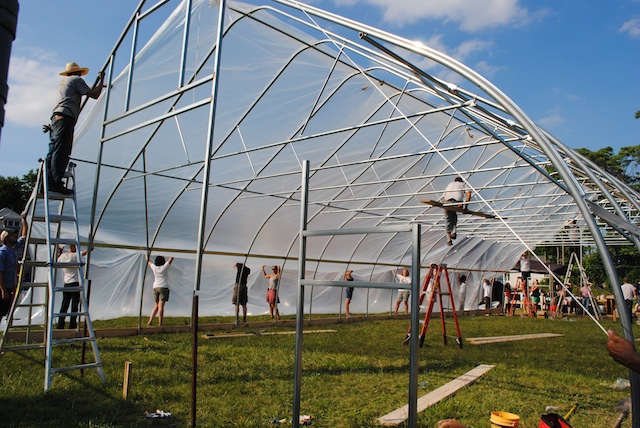
Cheers to the fact that living in a cold harsh northern clime doesn't preclude getting fresh veggies grown within driving distance of our wintry home. In a bid to boost local economies and reduce our reliance on the sunbelt and Mexico, hoop houses are rearing their heads around Washtenaw County.Call it the 21st century version of the barn-raising, where volunteer groups of 15-30 strong are convening to put up a hoop house a day. In the latest campaign by hoop house champion and local-food breakfast salon Selma Cafe, 15 of the structures were newly built in the 20 days between June 15 and Independence Day. Their locations include Sunseed Farm and the Tilian Farm Development Center, a new business incubator for farmers situated on a 150-acre plot in Ann Arbor Township.These quonset-hut shaped structures, made of metal tubing and sheathed in plastic, are a key element of four-season agricultural production in the upper latitudes, says Jeff McCabe, co-founder of Selma Cafe. "People that are interested in creating a viable food system are thinking about ways to make it not just something that happens in the summertime, like a vacation of local food, but a year-round food economy that people can count on."Summertime tomatoes, eggplant, and peppers thrive in the heat concentration, while hardy greens like spinach and brassicas sprout in winter, McCabe explains. Hoop houses moderate extreme winter temps, capturing the day's warmth and holding it overnight. "They're the difference between the ground being frozen and not," McCabe explains. A hoop house averages about 3,000 square feet, costs from $9,000 to $15,000 to build, and can produce about $10,000-20,000 worth of agricultural product per year, says McCabe. There are currently at least a couple dozen hoop houses in Washtenaw County, he estimates. He'd like to see their numbers grow into the hundreds.Some have been financed through the Farmer Fund, a partnership between Selma Cafe and University Bank that offers 100% loan financing and the option to defer payments until the hoop houses are bearing crops, according to McCabe.The food and beverage economy is valued at over a billion dollars a year in the county, according to the 10 Percent Washtenaw campaign."If we were going to re-localize 10% of that economy we'd be creating a $100-million food system in Washtenaw County that doesn't exist right now," McCabe notes. "Some of that would be restaurants, stores, and value-added products, but a big chunk of that – certainly tens of millions – could be food grown on new farms for both summer and winter production in Washtenaw County. That's what we're working on creating."Sources: Jeff McCabe, co-founder of Selma Cafe; 10 Percent WashtenawWriter: Tanya Muzumdar

EMU’s $42 million Pray-Harrold building revamp to be ready for students next month

Next month marks a new year on campus, with the long-awaited renovation of Eastern Michigan University's Pray-Harrold building to be done in time to receive over 10,000 students a day. The seven-story building is the largest on EMU's campus – it houses 10 departments of the College of Arts and Sciences, about 60 classrooms, and over 25% of the university course offerings. Nearly 300 faculty and staff report to work there.The project entailed repairs or replacement of all major mechanical, electrical, and plumbing fixtures in the 235,791 square-foot building. All IT and audio-visual systems were also upgraded, and the curtain wall replaced. New finishes can be found throughout, and every classroom is getting new furnishings."The aging systems and antiquated amenities had reached their life cycle limits, and considering that this building was constructed prior to the advent of personal computers, infrastructure needs were also critical," Seán Braden, manager of planning and design at EMU, says in an email.The state of Michigan funded 75% of the $42 million capital outlay project, with EMU covering the balance.Source: Seán Braden, manager of planning and design at EMUWriter: Tanya Muzumdar

Ypsilanti’s W. Cross St. enhancements, Complete Streets ordinance bring walkers on par with drivers

The Ypsilanti city council's approval in June of a Complete Streets ordinance, together with the impending completion of the W. Cross Street non-motorized enhancement project, means a more balanced intersection between driving, walking, and other forms of non-motorized transport is on its way to the city's downtown.The enhancement project underway is revamping the stretch of W. Cross Street from N. Washington to Summit Street and in Depot Town from River to Rice Street. By August 1 damaged curbs will be repaired and all intersections will be ADA-compliant and sport new stamped concrete bump-outs, says Tim Colbeck, Ypsilanti DDA director. "[The bump-outs] have the measure of slowing traffic down and making the street easier to cross by reducing the amount of distance a person has to walk across the street," he explains.With the turning of the fall leaves will come 82 new trees of different varieties. And the bump-outs in the Depot Town section of Cross Street will get rain gardens landscaped with drought-resistant native grasses and flora such as black-eyed susans. The rain gardens will funnel runoff and improve the quality of water draining into the Huron River, Colbeck says. LED lighting fixtures will spark the stretch between Washington and Summit Streets and, in cooperation with Eastern Michigan University, be dark-sky compliant. The idea is to have light focusing downward onto the street rather than emitting upwards and adding to light pollution. The lightpoles will be the last item so they aren't damaged during the concrete work.The project is costing in the range of $850,000 to $1 million, Colbeck says. The city of Ypsilanti is covering $170,000 of the cost, the DDA portion is $87,500, and the Michigan Department of Transportation is picking up the balance.While the project, five years in the making, was on the city's agenda long before Complete Streets legislation, the gist of which is that streets need to be designed to accommodate cars plus all other non-motorized forms of transit, was formalized, "Everything that we're doing right now is to make it a safer and friendlier place for people to walk. In principle, [Complete Streets theory] already was implemented as part of this project," Colbeck says.Source: Tim Colbeck, Ypsilanti DDA directorWriter: Tanya Muzumdar

The Varsity apartment project kicks off in Ann Arbor

If you seek a denser downtown, The Varsity, a 13-story, 173-unit apartment building intended to house about 418 residents – mainly students – may be next on Ann Arbor's horizon. The 178,380-square foot project under development by Potomac Holdings of Bethesda, Md., has just undergone a design review by the city's new design review board. It's intended to replace the squat two-story Ann Arbor Professional Building at 425 E. Washington Street, a block away from the University of Michigan campus.Plan documents call for a masonry exterior with cast stone, glass, and metal accents. The grounds will have a pedestrian plaza and a mews, or walkway. There will be a two-level parking garage, with 77 spaces, one level below and one above grade.Other features for the swank-minded include interior bike storage, a double-height lobby, and top-floor lounge and patio. Units range in size from studios to four bedrooms.The plans do not call for any commercial uses. "The Ann Arbor Design Review Board... suggested that ground floor retail would help to further enliven the plaza area on the south side of the building. The project design team said they would take the suggestion into consideration but it is really a decision for the developer to make," Ann Arbor City Planner Alexis DiLeo says in email. The project team will hold a citizen participation meeting on July 7 and then submit a site plan to the city's planning service department on July 25. Barring any major issues raised during the staff review, the petition should be presented at the September 20 city planning commission meeting and will then go before city council in November, DiLeo says.Source: Alexis DiLeo, Ann Arbor city plannerWriter: Tanya Muzumdar

Dexter’s Mill Creek Park to flower starting in July

A concerted effort over three years in the making will spawn a new creekside haven for the village of Dexter. Last week the city was awarded a $1.24 million contract for the first phase of construction of Mill Creek Park. Utica, Mich.-based Cedroni Associates, Inc. is expected to start work in mid-July and should be substantially complete by winter of 2012, with finishing touches that spring, says Allison Bishop, community development manager for Dexter. About $495,000 from various village funds will go towards project costs. The village has also received a $450,000 Michigan Natural Resources Trust Fund grant and $45,000 from the Waterways Infrastructure grant program. Washtenaw County is picking up the remaining $345,000, Bishop says. The work will extend from Forest Lawn Cemetery north to the Main Street Bridge. The new park will boast a stairway from the park to Alpine Street downtown, a restored stream, enhanced habitat, a fishing dock, a put-in and take-out for boats (one above and one below the Main Street dam), boardwalks and sidewalks, landscaping, an amphitheater, streetscape improvements on Jeffords Street, and a circular path. The park will be four acres large but work will be spread over a seven-acre plot on both sides of the creek. The property, a large grassy field, was formerly a dam impoundment. "It's an area that no one has ever been able to have access to and now we're providing a real great opportunity for people to get reconnected with the stream, sit and read a book, and enjoy nature just right outside of the downtown," Bishop says. Mill Creek Park will also link up to the county's Border-to-Border trail system. "It's a great asset to local land and regional trail enthusiasts." Source: Allison Bishop, community development manager for Dexter Writer: Tanya Muzumdar

Ypsilanti City Hall hopes to become a fixture in the LED light realm

Ypsilanti City Hall may become a showplace for LED lighting if its $100,000 grant application is approved.The funds are part of a $1 million pool made available earlier this spring by the Michigan Energy Office for municipalities to install advanced lighting technology demonstration projects. The grant would cover materials and equipment, with $86,000 from the city's revolving energy fund covering labor costs, says Stan Kirton, Ypsilanti's director of public services. "With the savings that we'll realize, we'll replenish that revolving fund and continue to do projects as we go along," Kirton says.Energy cost avoidance estimates are not yet available, but if all 400-plus light fixtures in City Hall were changed to LEDs, Kirton figures a minimum savings of 20-30% annually. Using the mayor's office as a demo for instance, when the city swapped four G12 florescent lights for a pair of LED fixtures, the electricity savings for that office alone was $195 per year. "If you consider all the hallways and all the other offices that we would upgrade, I think the amount will be substantial," he says.The public will be able to track savings and other stats on the Solar Ypsi website, Kirton adds.This is Ypsilanti's second shot at LED lighting grant funds; a prior application for an Energy Efficiency and Conservation Block Grant grant round was unsuccessful. At that time, five times as many municipalities applied as there was money to give, according to the Michigan Energy Office.City officials expect to learn of the decision in July.Source: Stan Kirton, Ypsilanti's director of public servicesWriter: Tanya Muzumdar

Our Partners

30044
30045
30046
30047
30049
Washtenaw ISD logo
Eastern Michigan University
Ann Arbor Art Center
UMS
U of M Arts Initiative
Engage EMU
Ann Arbor Housing Commission

Don't miss out!

Everything Ann Arbor and Ypsilanti, in your inbox every week.

Close the CTA

Already a subscriber? Enter your email to hide this popup in the future.