
University Lending offers $10,000 grants for low- and moderate-income homebuyers
University Bank’s lending division is providing up to $10,000 grants for low- to moderate-income borrowers in Washtenaw County to achieve their homeownership dreams.
The following story is part of a series highlighting solutions to housing and homelessness challenges in Washtenaw County. It is supported by the Ann Arbor Housing Development Corporation and University Bank.
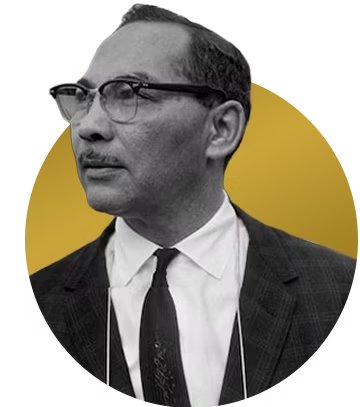
University Bank‘s lending division, University Lending Group, is providing up to $10,000 grants for low- to moderate-income borrowers in Washtenaw County to achieve their homeownership dreams. The Al Wheeler Neighborly Housing Grant is available to people making under 80% of the county’s average median income (AMI). The program is named after Dr. Albert H. “Al” Wheeler, Ann Arbor’s first Black mayor and a local community activist.
“We initiated the grant in July of 2024 with the initial amount of each grant being $5,000. In September of that same year, we doubled the amount to $10,000,” says Eric Bradley,
University Lending Group’s regional manager and senior vice president. “Since inception, we have provided 144 grants totaling $1.4 million, which helped 144 middle-income families here in Washtenaw County to purchase $38.7 million of affordable housing.”
The grant program was created after University Lending Group staff noted how home prices, taxes, interest rates, and closing costs were blocking local buyers. Bradley says closing costs can be a surprise that send borrowers “back to the drawing board,” even after they think they’ve saved enough to buy a home.
“It’s usually that last item. Someone can qualify for a mortgage, and they’ve saved and scrounged enough money to come up with the down payment,” he says. “Then they find out closing costs, in some cases, can be almost as much as the initial down payment.”
The Neighborly Housing Grant is designed to help buyers in that kind of situation cross the homeownership finish line. Bradley highlights that the program is unique because similar grants are often limited to borrowers making 60% of the AMI. He also underscores that financial institutions often advertise grants or down payment assistance programs that are actually loans. The Neighborly Housing Grant program provides a true grant. No interest accrues and it does not have to be repaid later.
“At closing, we have the new homeowner sign a disclosure stating that they acknowledge that these funds are theirs alone, solely for the use of down payment and or closing costs,” Bradley says. “They have to acknowledge that there is no repayment of those monies. That’s the best piece of paper to sign.”
More information on the program is available here.
Author

Related Articles

Who actually lives in Ann Arbor’s affordable housing?
Affordable housing residents are a diverse bunch who defy the stereotypes often assigned to them.
Washtenaw County housing documentary creators plan free screenings countywide
“The Road Home,” a new documentary examining challenges in Washtenaw County’s housing and homelessness systems, is now available for anyone interested in organizing a public or private screening.
Ann Arbor millage yields big results in affordable housing development
Over $27 million from Arbor’s Affordable Housing Millage has been spent or committed to 14 housing projects, four renovations, and five supportive services initiatives.


